

Der schnellste aller Wale – Der Finnwal
Finnwale, gemeinhin als Finnrückenwale oder Schwertwale are the second largest living mammal on the Earth and the second biggest rorqual whale falling just behind the majestic Blue whale. Like all rorqual whales they are an extremely cosmopolitan specie, found in all the major Oceans from polar to tropical waters. The outstanding Sea of Cortes is considered an all year round residency for some of the North Pacific population.
Wenn Sie Wale in ihrem natürlichen Lebensraum erleben möchten, begleiten Sie uns und erkunden Sie unser faszinierendes Walbeobachtungstouren in San José del Cabo • Los Cabos • Mexiko • B.C.S.
Aussehen
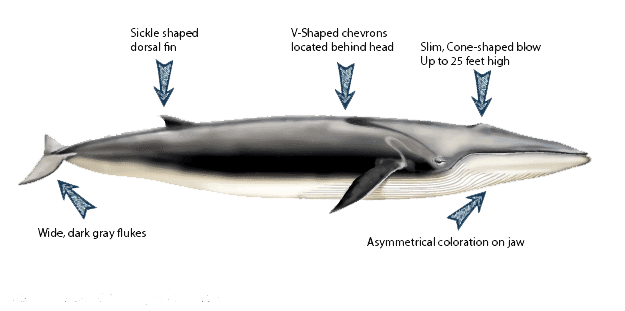
The Fin Whale is distinguished by their great size, streamlined bodies, pointed snout, flatter V shaped heads and unique dorsal fin. Their sleek bodies are a brownish dark grey above and white or cream color below like many other species . The pectoral fins are relatively short with pointed tips and the rear fluke slightly triangular with the same shadings.
Fins whales have a unique colorization feature among all other cetaceans – their faces are asymmetrical. The right side of their jaw , right lip and the right side of their baleens are a yellowish-white, while the left side is grey. Fin whales have been nick named the Razor back because of a distinct ridge behind their dorsal fin, the dorsal fin is located 2/3 down the back, it has a pointed tip and generally slopes backwards giving the fin a very distinguished look like no other dorsal fin. Fin whales can measure up to 85ft and weight between 40 to 80 tons.
Finnwale können leicht mit Seiwale oder Brydewale verwechselt werden. Hybridarten, die durch Kreuzung von Blauwalen und Finnwalen entstehen, können gelegentlich in freier Wildbahn beobachtet werden, was ihre Erkennung etwas komplizierter macht als bei anderen Arten.
Mexikanischer Name:
- Finnwal
- Finnwal
Maximale Länge:
- Männlich: 25m
- Frau: 27m
- Wadele: 6,5 Mio.
Maximalgewicht:
- Männlich: 70.000 kg
- Weiblich: 120.000 kg
- Kalb: 2.700 kg
Diät
- Kleine Wirbellose (Euphausiacea und Copepoda)
- Fisch (einschließlich Hering, Makrele und Sandaal)
- Tintenfisch
Geschätzte Bevölkerung: <100.000
Verteilung
Diese Wale findet man in allen Ozeanen der Welt. Sie bevorzugen tendenziell die Tropen, aber man kann sie auch in den Polarregionen finden. Die Mehrheit von ihnen scheint jedoch die meiste Zeit in den kühleren Gewässern zu verbringen. Es wird angenommen, dass dies auf die dort reichhaltigeren Nahrungsquellen zurückzuführen ist.
Bevölkerung und Migration
Es gibt zwei Unterarten des Finnwals: den Nordatlantik-Finnwal (lebt in den Ozeanen der Nordhalbkugel: *Balaenoptera physalus*) und den Südpazifik-Finnwal (lebt in den Ozeanen der Südhalbkugel: *Balaenoptera quayi*). Im Allgemeinen sind die nördlichen Arten kleiner als die südlichen.
Their world population is estimated to be between 80 000 and 100 000 individuals. Like many other whales fin whales were severely hunted in the 70’s. Fin whales are today still considered an endangered specie.
No specific migration pattern has been observed for these whales, but Iike all misticetes, Fin whales can migrate to subtropical waters for matting and calving during the winter months and to colder areas of the Arctic and Antartic for feeding during the summer months. Though recent evidence suggests that fin whales may disperse into deep ocean waters during winter rather than migrating between winter and summer regions, explaining the possibility of the presence of resident groups of fin whales in some areas, such as in the Sea of Cortes.
Finnwale haben eine lange Lebenserwartung, die bis zu 90 Jahre betragen kann.
Verhaltensweisen
Fin whales also renowned as being the greyhounds of the Ocean, they are fast swimmers with an average cruising speed of 18mph but theses olympic swimmer can reach bursts of out to 32mph. Fins have the capacity of breaching, typically landing on their belly provoking tremendous splashes. They do not seem bothered with boats and can easily outrun vessels and dive deep to get away from boats when felt threathened.
Finnwale schwimmen normalerweise in kleinen Gruppen von bis zu 6 Individuen, können aber bei der Nahrungsaufnahme oder Paarung in größeren Gruppen beobachtet werden.
Fin whales being the second biggest baleen whale count up to 100 grooves under their throats adding to their streamline shape, all of which can expand while when they lung feed of small fish or krill.
One of the reasons we know little about fins is because they can be pelagic whales meaning they spend most of their time out in the deep seas away from the coasts. Similar to they big cousin the blue whale they remain a secretive specie when it comes to their mating rituals.
Ihre Kommunikation ist ebenfalls sehr ähnlich der von Blauwalen. Finnwale stoßen tieffrequente Geräusche (Infraschall) aus, die bis zu 188 Dezibel laut sein können. Diese können vom Menschen nicht gehört werden, aber die Wale können sie bis zu 850 km weit hören.
Fortpflanzung
Die Fortpflanzung findet im Winter statt. Von der Empfängnis bis zur Geburt des neuen Babys dauert es etwa 11 Monate. Kälber sind etwa 21 Fuß lang. Es wird angenommen, dass sie bei der Geburt etwa 4.000 Pfund wiegen. Fast alle Wale haben nur ein Baby gleichzeitig, gelegentlich auch Zwillinge. Es wurde dokumentiert, dass der Finnwal manchmal bis zu sechs Babys gleichzeitig hat.