

Humpback Whale Anatomy, Facts and Migration
Humpback whale anatomy is easy to recognize once you know what to look for: long pectoral flippers, a small dorsal fin, knobbly tubercles on the head and a broad tail divided into two flukes. These baleen whales, Megaptera novaeangliae, are also known for their songs and active surface behavior.
This guide explains the anatomy of a humpback whale, its size, feeding, migration and breeding. The original labeled diagram below helps connect these features with what you may notice from a boat.
Humpback whales visit the Los Cabos region during their winter breeding season. For dates, departure options and booking information, see our separate whale watching tour in San José del Cabo.
Humpback whale size and appearance
Humpbacks have dark bodies with variable white markings on the belly, flippers and underside of the tail. Females are generally larger than males. Large adults can reach about 60 feet (18 meters) and around 40 US tons (36 metric tonnes); individual sizes vary.
Scientific name: Megaptera novaeangliae
Spanish name: Ballena jorobada
Whale group: Baleen whale in the rorqual family
Food: Krill and small schooling fish
These humpback whale facts help with identification, but no single color pattern fits every animal. Use several features together, including the long flippers, head shape and flukes.
Humpback whale anatomy
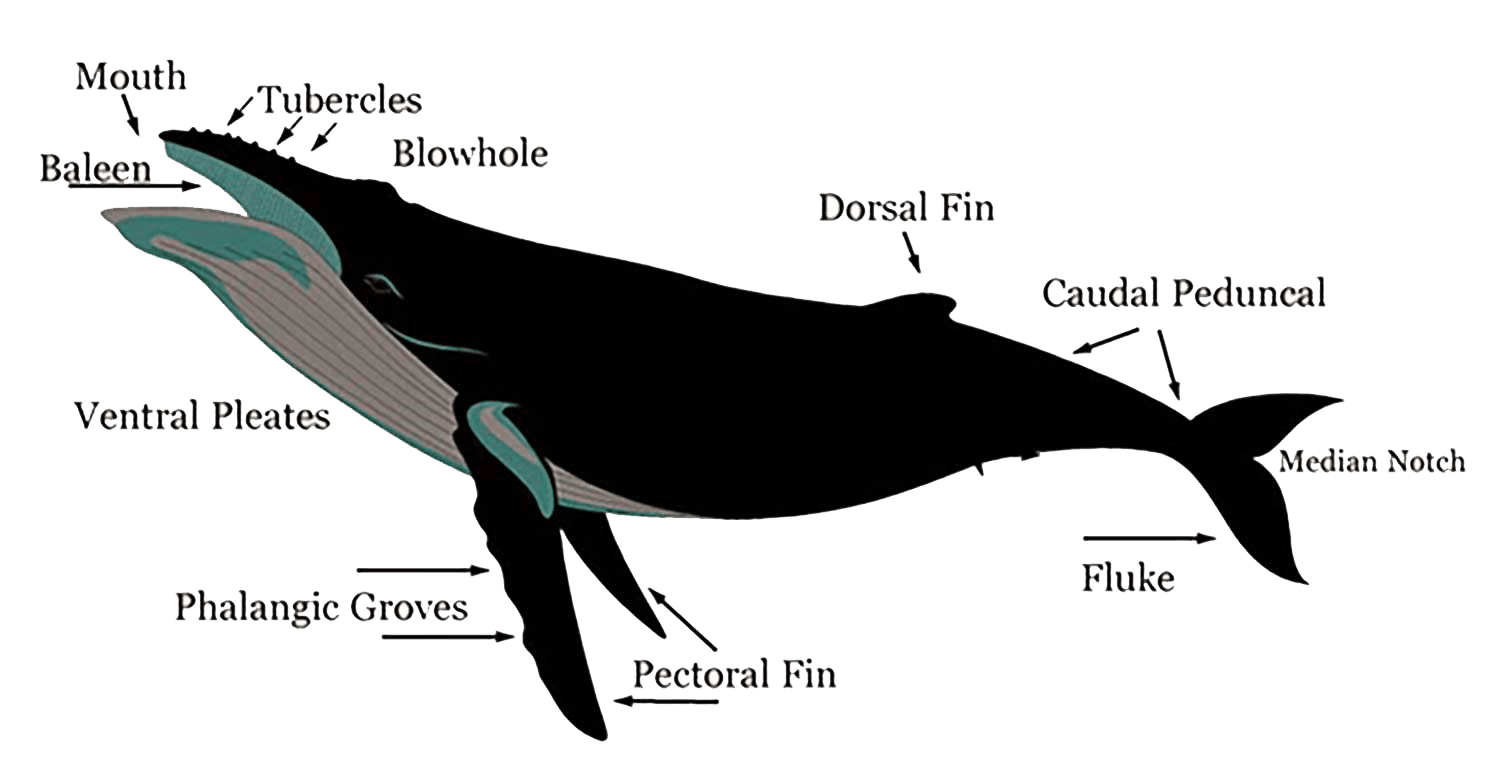
The diagram of a humpback whale below shows the external features used to recognize the species. Follow the body from the head to the tail:
Head and tubercles: Rounded bumps on the head and lower jaw are a distinctive identification feature. Two blowholes on top of the head allow the whale to breathe at the surface.
Pectoral flippers: The long paired forelimbs help with maneuvering and can reach roughly one-third of the whale’s body length. Their size inspired the name Megaptera, meaning “big-winged.”
Dorsal fin: The fin sits toward the rear of the back. Its shape varies between individuals, and the back arches noticeably as the whale dives.
Tail stock and flukes: The muscular tail ends in two broad flukes. The tail drives movement through the water, while the underside’s markings help researchers identify individuals.
Throat pleats and baleen: Expandable grooves under the throat let the mouth hold a large volume of water during feeding. Baleen filters prey from that water; adult humpbacks do not have teeth.
Populations and humpback whale migration
Humpback whales occur in the world’s major oceans, with distinct populations using different feeding and breeding areas. Most travel seasonally between productive cooler-water feeding grounds and warmer breeding grounds. The Arabian Sea population is an important exception to this usual migration pattern.
Humpback whale migration brings animals to the waters around Baja California Sur during the northern winter. The region is part of a wider North Pacific network connecting breeding and feeding areas.
Tail flukes: a whale’s fingerprint
Black-and-white patterns, the shape of the trailing edge and scars on the underside of the tail can distinguish one humpback from another. Researchers compare fluke photographs in identification catalogs to document individuals over time.
A clear photograph can therefore be useful beyond the memory of an encounter. Identification depends on image quality and comparison with a catalog, rather than assuming every whale can be recognized from any photograph.
Long journeys and conservation
Some humpbacks travel thousands of kilometers between feeding and breeding areas. Migration distance depends on the population and route, and individual movement patterns vary.
Commercial whaling severely reduced their numbers. Many populations have recovered, but conservation status differs between populations, and threats include fishing-gear entanglement, vessel strikes and ocean noise. See the NOAA Fisheries species profile for current conservation information.
Breaching and other surface behavior
Humpbacks may breach, slap the water with their tails or flippers, raise their heads in a spyhop or rest near the surface. A breach is a leap that lifts much of the body out of the water.
These actions have different possible functions depending on the situation. Communication is one proposed role, but there is no single proven explanation for every breach. A quiet encounter is just as natural as an active one, and a tour cannot promise any particular behavior.
Humpback whale song and communication
Humpback whales produce a range of sounds. Males are known for long, patterned songs, especially around breeding areas, while both sexes produce other calls. Songs change over time, and researchers continue to study their roles in reproduction and social communication.
A hydrophone can make underwater sounds audible from a boat when conditions and whale activity allow. Hearing a song is not guaranteed on every trip. NOAA’s humpback whale acoustics page provides further background.
Reproduction and calves
Females usually give birth to one calf after roughly 11 to 12 months of pregnancy. Calves are around 13 to 16 feet (4 to 5 meters) long at birth and nurse close to their mothers. The interval between births is commonly two to three years.
Mother-and-calf pairs need space to rest, nurse and travel. Observe from a respectful distance and follow the crew’s instructions when watching whales from a boat.
Baleen and feeding techniques
Humpbacks take krill and small schooling fish into their mouths with seawater, then use baleen to retain the prey as water flows out. The expandable throat pleats are an important part of this feeding anatomy.
Some individuals or groups use bubbles to concentrate prey before lunging through it, a technique called bubble-net feeding. Feeding methods differ between places and populations; bubble-netting is not a promised sight on a Cabo winter tour.
Many humpbacks feed intensively in cooler waters and rely heavily on stored energy during migration and breeding, although some opportunistic feeding also occurs. Learn more in the International Whaling Commission’s humpback whale guide.
Humpback whale questions
How big is a humpback whale?
Large adult humpbacks can reach around 60 feet (18 meters) long and about 40 US tons (36 metric tonnes). Females are generally larger than males. A newborn calf is much smaller, at around 13 to 16 feet (4 to 5 meters) long.
Why do humpback whales breach?
Breaching may serve several functions, including communication, and the reason for an individual breach is not always clear. Humpbacks also slap their tails and flippers or rest near the surface. These are natural behaviors; an encounter does not always include a breach.
Do humpback whales have teeth?
No. Adult humpbacks are baleen whales. Plates of baleen help strain krill and small fish from seawater, while expandable throat pleats let the mouth take in a large volume during feeding.
When can you see humpback whales in Cabo?
Winter and early spring are the main seasonal period for humpbacks around Los Cabos, as whales use warmer waters for breeding and calving. Check the San José del Cabo whale watching tour for current departure dates and availability. Sightings and particular behaviors vary naturally.
How can I use the humpback whale anatomy diagram?
Start at the head and locate the tubercles and blowholes, then follow the body to the long pectoral flippers, dorsal fin and tail flukes. Compare the labels with the anatomy descriptions above. Several features together are more useful for identification than one feature alone.
Why do humpback whales sing?
Male humpbacks are known for long, complex songs, especially in breeding areas. Researchers study how these changing patterns relate to mating and social communication. Other calls are produced by both sexes, and hearing a song depends on whale activity and listening conditions.